
On October 21, Marathon Fusion posted this on X:
Last month, we demonstrated high-rate alchemy: turning mercury into real, stable gold, beating CERN's record by a factor of 10. … Now, we're building a fusion reactor in San Francisco to achieve record power density.
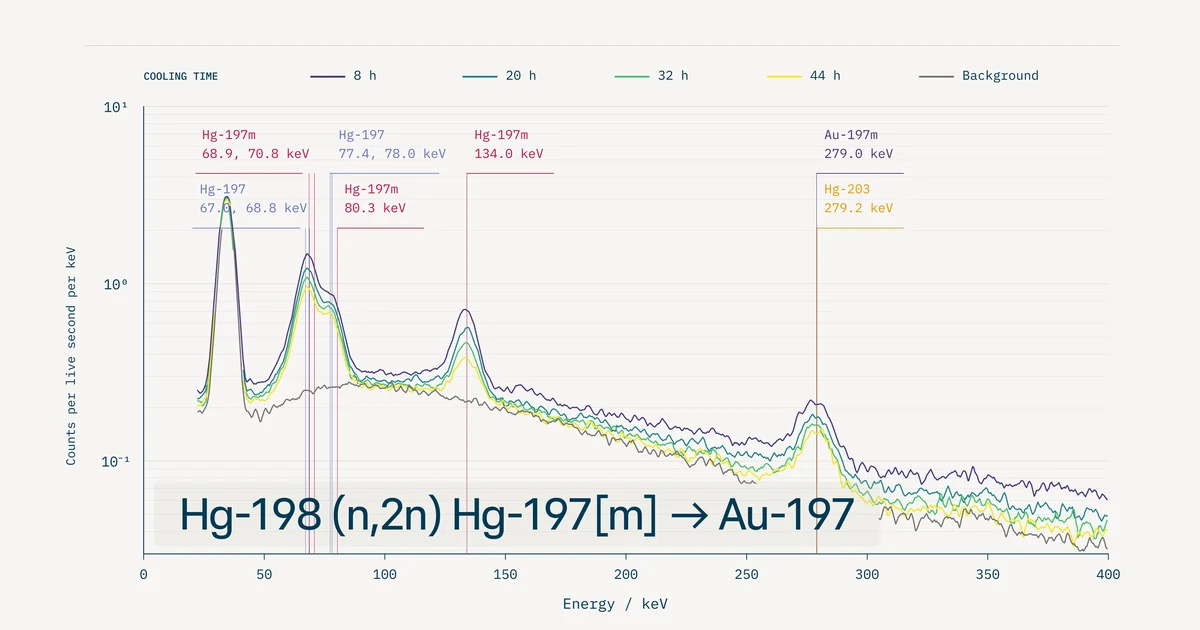
and, further down the same thread, next to a gamma spectrum:
In 2025, we published a bold proposal to use fusion reactors for gold production. And now we've done it: Mercury transmuted into stable gold, using fusion neutrons, at 10x the record set by CERN in 2025. We've reduced alchemy to a series of difficult but tractable engineering problems.
What the thread does not contain: the mass of gold produced, the number of gold atoms, the neutron yield, the mass or chemical form of the sample, the irradiation time, the name of the neutron source, or a definition of what "10x" is ten times of — a rate, or a total. The thread promises no preprint, no data release and no third-party verification. As of October 24 the company had added nothing on X, LinkedIn or its own newsroom, and had not answered the technical questions under the thread. Its /alchemy page still carries the 2025 proposal, with nothing from the September experiment.
So the whole of the public evidence is one image. It is worth reading, because it does prove something — just much less than the headlines it produced.
What the spectrum shows
The figure at the top of this post is that image — Marathon Fusion's own, posted on X on October 21, 2026. Four cooling times — 8, 20, 32 and 44 hours after irradiation — plus a background trace, counts per keV per live second. No sample mass, no irradiation time, no neutron fluence, no detector model, no efficiency, no geometry, no error bars.
Every line labelled on it (67.0/68.8, 68.9/70.8, 77.4, 134.0, 279 keV) matches IAEA decay data. The 134 keV peak falls across the four cooling times at a rate corresponding to a half-life of roughly 21–23 hours, which is Hg-197m, the metastable state of mercury-197, whose half-life is 23.8 hours. Mercury-197 decays, 100% of the time, to gold-197, which is stable and is the only stable isotope of gold.
That chain is solid. Stable gold atoms were made. But nobody saw gold in this spectrum: gold-197 is stable and emits nothing. What the detector saw was mercury-197 on its way to becoming gold.
Four things the spectrum cannot establish:
- How much gold. With no efficiency calibration, no sample mass and no geometry, the same ~4 counts per second at 134 keV is consistent with gold atom counts spanning more than four orders of magnitude. Working backwards from the detection efficiencies typical of this kind of measurement — 10⁻³ to 10⁻² — gives roughly 4×10⁸ to 4×10⁹ atoms, which is 0.1 to 1 picogram. A picogram of gold is worth about a ten-millionth of a cent.
- Whether "10x CERN" holds. Neither a rate nor a total is given, so neither reading of the claim can be confirmed or ruled out.
- That the reaction was (n,2n). Mercury-196 captures thermal neutrons to make mercury-197 too, with a cross-section around 3,080 barns — enormous. The spectrum contains mercury-203 lines that decay too slowly to be anything else, which means slow neutrons were present at the sample. Thermal capture only has to supply a few percent of the fast-neutron flux to compete.
- Reproducibility. No counting conditions, no uncertainties, one run.
One detail the figure gives away: the peaks are about 8% wide, roughly 11 keV at 134 keV. That is a scintillator, not a high-purity germanium detector — a detector that cannot separate the X-rays of gold from those of mercury.
A second figure in the thread, of irradiated zinc, is more informative about the machine than the mercury one is. It labels zinc-63, which can only be made by zinc-64 (n,2n) with a threshold around 12 MeV. So the neutrons were almost certainly 14 MeV D-T fusion neutrons, not the 2.45 MeV of D-D.
That is the one genuinely new word in the claim: fusion. It is also doing less work than it appears to.
Why the record is a low bar
CERN's gold comes from the ALICE experiment's measurement of lead nuclei passing close enough to each other for the electromagnetic field to strip off three protons. Across the LHC's second run, 2015–2018, all four experiments together made about 8.6×10¹⁰ gold nuclei: 29 picograms. Peak rate at the ALICE collision point was about 8.9×10⁴ nuclei per second. The nuclei hit the beam pipe immediately and cannot be collected. ALICE's deputy spokesperson has put it in terms of production: at that rate, one gram of gold takes around 100 billion years.
CERN was never trying to make gold. It is a baseline, not a target, and it sits very low:
- A routine 14 MeV cross-section measurement, at roughly 3×10¹¹ neutrons per second, makes gold at something like 20 to 30 times CERN's peak rate. At least six laboratories have run that measurement on mercury-198 since 1968.
- Neutron activation analysis, a standard way of measuring how much mercury is in a sample, irradiates a gram of natural mercury in a research reactor for an hour and makes about 160 nanograms of gold along the way — roughly a million times CERN's peak rate. Analytical chemists have been doing accidental alchemy for decades.
And the physics is 85 years old. In 1941 R. Sherr, K. T. Bainbridge and H. H. Anderson at Harvard irradiated mercury with fast neutrons from the lithium-plus-deuteron reaction and identified mercury-197 for the first time. By the same decay chain, they had already made stable gold — atom by atom, unweighed. The reverse direction turns out to be the easy one: in 1947 the US National Bureau of Standards extracted about 60 milligrams of mercury-198 from irradiated gold, to fill a lamp for a length standard. Sixty milligrams is a hundred million times more material than the picograms at stake here, going the other way.
So: a company demonstration of known physics, with one figure, no numbers, and no independent verification. Not a physics breakthrough. The interesting document is not the thread. It is the paper the thread refers back to.
What the paper actually proposes
Scalable Chrysopoeia via (n,2n) Reactions Driven by Deuterium-Tritium Fusion Neutrons (arXiv:2507.13461) is by Adam Rutkowski, Peter Harter and Jason Parisi, all three under Marathon's own San Francisco address. It is a neutronics study, and its central idea is genuinely clever.
A deuterium-tritium fusion plant has to breed its own tritium. One D-T reaction consumes one tritium and yields one neutron, so a plant needs to get more than one tritium back per neutron — a tritium breeding ratio above 1 — and that requires multiplying neutrons somewhere in the blanket. The standard way is an (n,2n) reaction on beryllium, lead or lithium-7: one neutron in, two out.
The paper's move is to multiply with enriched mercury-198 instead. The same (n,2n) reaction that splits one neutron into two also turns mercury-198 into mercury-197, which becomes gold. The gold is not a separate process competing for neutrons. It is what the neutron multiplier turns into. On that framing the gold is close to free.
Modelled in OpenMC on an ARC-class tokamak at 1,500 MW thermal, the reference case gives:
- 2,953 kg of gold per year, about 2 tonnes per GW of thermal power per year
- a tritium breeding ratio of 1.19, so tritium self-sufficiency survives the substitution
- a mercury-198 inventory of 622 tonnes, of which 0.47% converts per year
- at $100,000/kg, gold revenue comparable to electricity revenue, lifting the plant's net present value from roughly breakeven on electricity alone to over $3 billion
One unit to watch: the "5 tonnes per GW" figure that circulated widely is the company's framing in terms of electrical power. The paper's number is about 2 t/GW-thermal. At 40% conversion efficiency the two are the same order of magnitude, but "5,000 kg per GW-thermal" — which some coverage printed — is simply wrong.
The physics underneath holds up. The mercury-198 (n,2n) cross-section at 14 MeV has six independent measurements averaging about 1.98 barns, consistent with the value the paper uses. The cooling-time calculations can be reproduced. The authors are explicit that this is a neutronics concept study with no thermal, magnetohydrodynamic, structural or gold-extraction engineering behind it.
It is the distance from that concept to a tonne of gold that the announcement did nothing to shorten.
What stands in the way
The gold is radioactive for about two decades. Mercury-196, 0.15% of natural mercury, undergoes the same (n,2n) reaction to give gold-195, which has a 186-day half-life. The reference plant makes about 289 grams of it a year, mixed inseparably into the product — same element, same chemistry. The paper's own cooling times: 6.8 years to qualify as NRC Class A low-level waste, 13.7 years to fall below the transport threshold for radioactive material, 17.7 years to be less radioactive per troy ounce than a banana. The 13.7-year figure is a transport standard, not a licence to sell to the public. The NRC's exempt-concentration table for consumer products does not list gold-195 at all, so the catch-all value applies, and that works out closer to 20 years.
None of the three Marathon papers discounts that wait in its net present value. At the 8% rate the first paper uses, delaying the gold revenue 14 years cuts its present value from $3.38 billion to $1.15 billion. The headline NPV does not survive its own cooling period.
Enriched mercury-198 does not exist at any relevant scale. The reference plant needs 622 tonnes of it, which means processing roughly 11,800 tonnes of natural mercury. Mercury-198 is about 10% of natural mercury, and today its isotopes are quoted per milligram. The three Marathon papers assume $2.4, $1,000 and $3,000 per kilogram — three orders of magnitude apart. The $2.4 figure is the lamp electricity for a single photochemical excitation step, by the authors' own description; it excludes multi-stage enrichment, chemical reduction and the handling of twelve thousand tonnes of feedstock. The best photochemical pilot reactor on record ran at 0.4 grams per hour.
The blanket runs hotter than mercury boils. Mercury boils at 629.8 K at atmospheric pressure. The design temperature is 900 K, where extrapolated vapour pressure is around 30 bar. That makes the gold-bearing loop a pressurised liquid-metal circuit, which the paper does not discuss. The structural material chosen, a vanadium alloy, has no published compatibility data in mercury at all; above about 480 °C the older literature leaves only tantalum and niobium-zirconium. For comparison, the largest mercury loop running today — the 20-tonne target at the Spallation Neutron Source, two decades of operation — runs below 90 °C. There is no magnetohydrodynamic pressure-drop estimate for a mercury blanket in a tokamak's magnetic field, and no data at all on tritium solubility in liquid mercury.
Getting the gold back out has never been demonstrated. The proposal is to sorb gold onto copper or tantalum downstream, supported by a single sentence and a 2010 workshop citation. Gold dissolves in mercury only to about 0.12 atomic percent at room temperature; three tonnes of gold accumulating in seven hundred tonnes of mercury exceeds that, so extraction has to be continuous or the cold leg plates out. Nobody has pulled gold continuously from flowing hot mercury, let alone from mercury carrying a strong mercury-203 activity. The nearest analogue — recovering platinum-group metals from nuclear waste — has been studied for decades without reaching commercial use.
Most of the mercury the papers count on cannot legally be bought. The papers treat the US Department of Energy's ~1,700 tonnes, the Department of Defense's ~5,000 tonnes and the EU's ~6,000 tonnes as available feedstock. The US Mercury Export Ban Act has prohibited federal agencies from selling, transferring or distributing elemental mercury since October 2008; the United States' own 2025 report to the Minamata Convention states that about 5,600 tonnes of federal mercury "cannot be sold" on the US or world market. EU Regulation 2017/852 Article 11 requires mercury from the chlor-alkali industry and other listed sources to be disposed of in a way that does not permit recovery in any form. The Minamata Convention bars new primary mercury mining and asks parties to discourage new manufacturing processes that use mercury unless they can demonstrate to the Conference of the Parties both a significant benefit and the absence of a feasible mercury-free alternative — which is awkward, since beryllium and lead also multiply neutrons, and gold can also be mined.
And none of it is peer-reviewed. All three Marathon papers on this are arXiv preprints with no journal version. Of the eight citations to the first one, five are Marathon's own later preprints. Two of the people thanked as reviewers in it subsequently became co-authors on Marathon papers. The most-quoted outside endorsement, from a PPPL scientist who told the Financial Times the paper "looks great on paper", is from one of the company's own scientific advisers. As of October 24, no named nuclear physicist had publicly commented on the October experiment or its spectrum, and no independent group had attempted to reproduce the neutronics.
The size of the gap
The reference plant would produce gold at about 2.8×10²⁰ atoms per second. "Ten times CERN's peak" is about 9×10⁵ atoms per second. The two differ by a factor of roughly 3×10¹⁴.
Closing that is not a matter of scaling up a bench experiment:
- No device anywhere produces more than about 10¹⁴ D-T neutrons per second in steady state. The record is around 5×10¹³, a company figure from SHINE Technologies.
- ITER, at 500 MW from 2039, would support about 0.9 tonnes of gold a year as a 4π upper bound — but ITER has test-module ports, not a mercury blanket.
- Marathon's own machine, the one being built in San Francisco, targets 1 kW of fusion power. Even that, with a perfect enriched-mercury blanket all around it, tops out near 2 grams of gold a year. The company says, correctly, that the value of a 1 kW machine is in medical isotopes. One of its own preprints notes that neutrons from a D-T generator cost at least ten million times the value of the gold they make.
- Gram-scale blanket experiments wait on machines around 2030. Kilogram and tonne scale waits on a GW-class D-T plant running year-round, which is mid-to-late 2030s at the earliest.
Does any of this touch the gold price
Between the announcement and October 24, gold fell about 3.3%, from roughly $4,130 to $3,995 an ounce. Reuters and Kitco attributed the move to crude oil, jobless claims and the Fed. None of them mentioned Marathon Fusion. Gold had already fallen about 6% over the preceding month. The only outlets connecting the two were crypto newswires, one of them citing an anonymous X account for a figure of $406 billion in "evaporated" gold market value. The LBMA, the World Gold Council and the Responsible Jewellery Council have all said nothing.
For scale: mined gold production in 2025 was 3,672 tonnes, and the above-ground stock of all the gold ever mined is about 222,600 tonnes. The paper's own arithmetic is that fusion would need 1.65 TW of thermal capacity to match annual mine supply. A rule of thumb the World Gold Council cites without endorsing puts roughly 1% of price movement on every 25 tonnes of supply change. Ten tonnes a year of fusion gold is under 1%. A hundred tonnes a year is a few percent. A thousand tonnes a year — 500 GW of fusion thermal capacity — is tens of percent, at which point the business case consumes itself: the one unambiguous conclusion is that the "supply the whole gold market" version of the pitch destroys its own revenue assumption.
The comparison everyone reaches for is lab-grown diamonds, where wholesale prices have fallen 90–95% since 2015. It does not transfer. Lab diamonds can be told apart from mined ones, and diamond value leans heavily on a natural-scarcity story. Gold-197 after decay is identical to mined gold — chemically and isotopically, since gold has only one stable isotope — and most of gold's bid is central banks and investment demand, which do not care where the atoms came from. The emeritus director of the Max Planck Institute for Plasma Physics has put the realistic early figure at around 20 tonnes a year from existing waste mercury, and said gold will never become worthless.
Add the timeline. A GW-class D-T plant in the mid-to-late 2030s, plus roughly twenty years of cooling, puts the first fusion gold on a consumer market somewhere in the 2050s.
The diamond coincidence
There is one irony worth getting right, because the obvious version of it is wrong.
Anglo American, which owns 85% of De Beers, co-led Marathon Fusion's $5.9 million seed round with 1517 Fund on July 18, 2024. De Beers posted a roughly $511 million underlying loss in 2025, shut down Lightbox — the lab-grown diamond brand it had launched in 2018 — and is reportedly being sold by its parent.
But the seed round was raised to build tritium fuel-cycle systems; the press release says so in its title. It closed a year before the gold paper appeared and well before De Beers's 2025 loss. There is no evidence Anglo American invested because of gold, and it has not commented publicly on the gold claim.
So: a mining group whose diamond business was damaged by synthetic diamonds happens to have backed, two years earlier and for unrelated reasons, a company now claiming it can make gold. Coincidence and irony — not causation.
What would change the picture
A preprint with the neutron source, source strength, sample mass and enrichment, irradiation time, detector efficiency and a gold atom count — plus a definition of "10x". Chemical separation and mass spectrometry, confirming gold directly instead of inferring it from a decay chain. An independent neutronics reproduction of the blanket, ideally across nuclear data libraries, since the (n,2n) cross-sections for mercury-199, 201 and 202 have never been measured at all. Compatibility data for a vanadium alloy in 900 K mercury. A regulator saying anything about selling transmuted gold.
Until some of that exists, the accurate summary is narrower than either the announcement or the debunking: the reaction is real and old, one spectrum shows it happened again, and the ton-scale version is a chain of about six unsolved engineering problems with a twenty-year cooling period on the end.
Sources
- Marathon Fusion, X thread, October 21, 2026, and the gold post
- A. Rutkowski, P. Harter, J. Parisi, Scalable Chrysopoeia via (n,2n) Reactions Driven by Deuterium-Tritium Fusion Neutrons, arXiv:2507.13461
- ALICE Collaboration, Proton emission in ultraperipheral Pb-Pb collisions, Phys. Rev. C 111, 054906 (2025)
- R. Sherr, K. T. Bainbridge, H. H. Anderson, Transmutation of Mercury by Fast Neutrons, Phys. Rev. 60, 473 (1941)
- IAEA, ¹⁹⁷Hg decay radiation data
- IAEA Nuclear Data Section, EXFOR mercury-198 (n,2n) cross-sections
- NIST, mercury thermophysical data
- US Government, National Report to the Minamata Convention, 2025
- Regulation (EU) 2017/852, Article 11
- 10 CFR 30.70 Schedule A
- K. Lackner, interview, Max Planck Society
- A. Bevan, A company says it could turn mercury into gold using nuclear fusion, The Conversation
- PR Newswire, Marathon Fusion closes $5.9M seed round to process fuel for fusion energy, July 18, 2024
- World Gold Council, full-year 2025 Gold Demand Trends and above-ground stocks